

A New Approach to ACL Tear Treatment
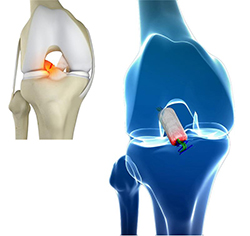
Anterior cruciate ligament (ACL) tears are among the most common sports injuries affecting athletes and active individuals. Traditionally, treatment has involved ACL reconstruction using tendon grafts harvested from the patient or donor tissue. The BEAR® (Bridge-Enhanced ACL Restoration) Implant offers an innovative alternative designed to help the body heal the torn ACL while preserving the native ligament. The BEAR Implant is the first FDA-approved technology developed specifically to restore a torn ACL rather than replace it.
As a fellowship-trained sports medicine surgeon specializing in shoulder, elbow, and knee injuries, Dr. Momaya offers advanced treatment options focused on restoring function, stability, and return to sport.
What Is the BEAR® Implant?
The BEAR Implant is a bioengineered collagen-based implant placed between the torn ends of the ACL to create an environment that supports healing. Unlike traditional ACL reconstruction, the procedure does not require harvesting a tendon graft from the patient or using donor tissue.
During surgery, the implant is saturated with a small amount of the patient’s blood and positioned between the torn ligament ends. This creates a bridge that supports the body’s natural healing process while maintaining the ACL’s original attachments to the femur and tibia. As healing progresses, the implant is gradually absorbed by the body.
Potential Benefits of the BEAR Implant
The BEAR procedure may provide several advantages compared with traditional ACL reconstruction:
- Preserves the patient’s native ACL anatomy
- Avoids graft harvesting and donor tissue use
- Eliminates the need for a second surgical site
- Maintains original ligament attachment points
- May reduce donor-site pain and weakness associated with graft harvest
- Supports biologic healing of the ACL
- May improve muscle strength recovery in some patients
- Designed to preserve natural knee mechanics
Who May Be a Candidate?
The BEAR Implant is not appropriate for every ACL tear. Ideal candidates generally include:
- Patients aged 14 years or older who are skeletally mature
- Complete ACL rupture confirmed by MRI
- ACL tissue remaining attached to the tibia
- Surgery performed within approximately 50 days of injury
- Active individuals seeking ACL restoration rather than reconstruction
Dr. Momaya performs a comprehensive evaluation including physical examination, imaging, activity goals, and injury pattern assessment to determine whether BEAR restoration or traditional ACL reconstruction is most appropriate.
How Is the Procedure Performed?
The BEAR procedure is performed arthroscopically through small incisions. Sutures are first used to stabilize the torn ACL. The implant is then placed between the ligament ends and infused with the patient’s blood to promote clot formation and healing. The ACL ends are secured into the implant, creating the bridge that supports restoration. Over time, the implant resorbs while native tissue heals and remodels.
Recovery After BEAR Implant Surgery
Recovery includes a structured rehabilitation program emphasizing protection of the healing ligament, restoration of motion, strengthening, and progressive return to activity.
Because healing occurs within the native ACL, rehabilitation protocols may differ from standard ACL reconstruction and often require careful progression during early recovery.
Sports Medicine Expertise for ACL Injuries
Dr. Amit Momaya specializes in sports medicine procedures involving the knee, including ACL injuries, meniscus tears, cartilage restoration, ligament reconstruction, and athlete care from youth sports through professional competition. Treatment plans are individualized to help patients safely return to the activities they enjoy.


