

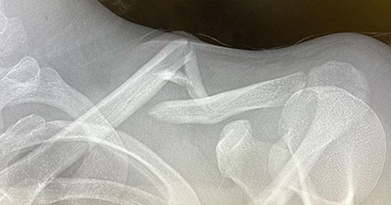
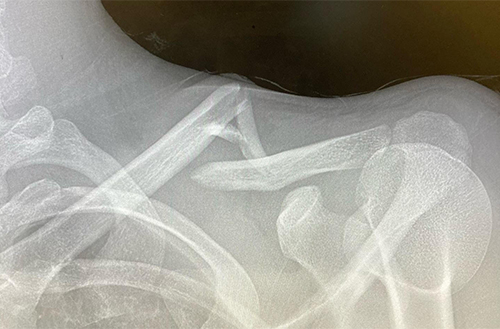
Figure 1
Clavicle, or "collar bone," fractures can happen from various mechanisms. They most commonly occur in the setting of motor vehicle and biking accidents or in a sports injury. They can occur when one falls onto an outstretched arm or gets direct contact to the shoulder area from the ground or another athlete. One typically feels a crack or pop with subsequent swelling in the area. It may be difficult to raise the arm after the injury due to pain. Figure 1 demonstrates a displaced clavicle fracture and Figure 2 demonstrates the clavicle after operative fixation with plate and screws.
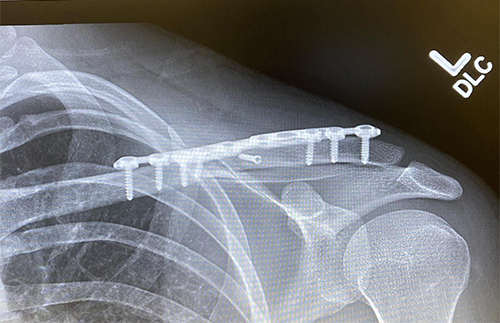
Figure 2
It is important to get immediate treatment after a clavicle fracture. Typically, an exam is done to ensure that the nerves and blood vessels have not been injured. The skin is examined to make sure there is not compromise to it. An xray is taken to determine how far apart the bones (displacement) are from each other.
There are multiple variables to consider if the clavicle fracture needs surgery. Some absolute indications for surgery include an open fracture (where bone has come out of the skin), skin tenting (a spike of bone is pushing on the skin), or subclavian artery or nerve injury.
Some relative indications to fix a clavicle fracture are displacement greater than 100% with greater than 2 cm of shortening, bilateral clavicle fractures, or a polytrauma patient. Also, we offer clavicle surgery to those who are looking to return to sport or work quicker.
Fixing a clavicle fracture has a higher union rate (the bone actually heals) compared to non-operative treatment. With fixation, the bone also heals much quicker compared to non-operative treatment (16 weeks versus 28 weeks). If a displaced and shortened fracture is treated non-operatively, the patient may have decreased shoulder strength and endurance. Age is also an important factor. Young, adolescent patients will almost always heal and remodel the clavicle regardless of displacement, unlike adults.
Here is a video demonstrating the fixation of a clavicle fracture by Dr. Momaya.
Dr. Momaya is a board certified orthopedic surgeon who specializes in sports medicine in Birmingham, AL. He serves as the Chief of Sports Medicine at UAB Medicine. This blog post is for educational purposes only. Please consult with a board certified orthopedic surgeon if you have injured your clavicle.


