

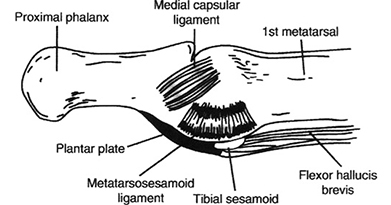
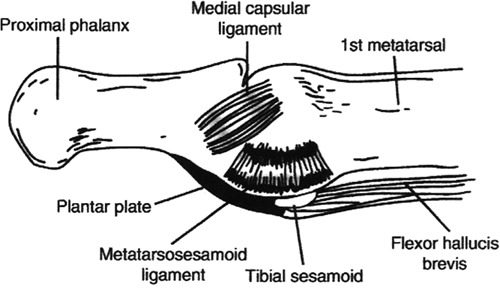
The name turf toe comes from noticing an increased incidence of turf toe injuries with the widespread use of artificial turf fields in 1970s. Turf toe is the result of a hyperextension injury to the big toe metatarsophalangeal (MTP) joint which damages the plantar structures (plantar plate and sesamoid complex) of the big toe. This most commonly happens when a player has the ball of their foot planted on the ground with their heel elevated, and another player lands on the back of their foot causing hyperextension of the MTP joint. Recently, Joe Burrow was reported to have a severe turf toe requiring surgery.
Anatomy
There are several structures that can be involved in this injury which include the joint capsule, the collateral ligaments (which run along the side of the joint), the sesamoids bones (2 small circular shaped bones that lie underneath the metatarsal head which are very important for push-off strength), the plantar plate (a thickened portion of the capsule which helps connect the 2 sesamoid bones to the base of the proximal phalanx).
Evaluation
These injuries can be very subtle when you are evaluating them. However, if someone has pain and swelling of their first MTP joint after an acute injury, this is something that we should always be on the lookout for. Symptoms are usually pain (especially with extension of the 1st MTP joint), swelling and stiffness. Most notably is the inability to or significant pain with push off during walking. Patients typically have tenderness directly over the plantar ligamentous complex. You want to assess the stability of the 1st MTP joint by bringing it through a range of motion as well as testing the collateral ligaments (by moving the toe side to side).
Imaging:
Initial imaging begins with xrays to look for any fracture or dislocation. A lot of times these xrays are normal, but you may be able to see a small fleck of bone representing an avulsion fracture. One very important thing to look for is the sesamoid position. The tibial sesamoid (the most inner one) should be less than or equal to 3mm from the joint line and the fibular sesamoid (closest to the second toe) should be less than or equal to 2.7mm from the joint line. Oftentimes it is useful to get xrays of the uninjured foot as well, to compare the patient’s normal sesamoid position to that of the injured foot. One indication of a turf toe injury is if the sesamoids have migrated proximal- meaning their position is farther up towards the ankle than on the other side
Another image you can get is a forced dorsiflexion view. When you extend the MTP joint, the sesamoids should travel distal and remain underneath the metatarsal head. If the plantar plate is completely disrupted, you will see that the sesamoids stay in the same position and not travel with the rest of the toe.
MRI is not always necessary if the diagnosis can be made with plain xrays, but can be useful in more subtle injuries and to further evaluate exactly which structures are injured and to what degree.
Grading and Treatment
There are 3 different classifications of turf toe injury:
- Grade 1 is a sprain of the plantar plate. Usually athletes can return to play as tolerated. Wearing a stiff soled shoe with an insert (turf toe plate insert) can be helpful symptomatically as well as to protect the toe as it continues to heal.
- Grade 2 is a partial tear. Typically athletes will be out of play for a few weeks to allow for a period of protected weight bearing in a boot. After this is a gradual return to play based on symptom resolution. Again, the shoe wear modifications mentioned for grade 1 injuries are recommended.
- Grade 3 is a complete tear. If treated nonoperatively, this usually requires a longer period of non weight bearing, and can take up to 6 months to completely recover.
When should you consider surgery?
This can be a difficult decision, but there are specific indications when surgery should be considered for grade 3 injuries.
- MTP joint is unstable
- There is abnormal widening between the 2 sesamoids
- A fracture of the sesamoid with gapping between the 2 fragments (diastasis)
- Retraction of the sesamoids (where their position moves up towards the ankle instead of remaining beneath the metatarsal head)
- Traumatic hallux valgus (bunion deformity)
- If there is a loose body within the joint itself
- Cartilage injury to the joint
- Failed nonoperative treatment
Outcomes
While there are not many studies that have looked the outcomes of these injuries, there are a few which overall showed most athletes do return to full play, but several did have residual pain and stiffness of their big toe.


