

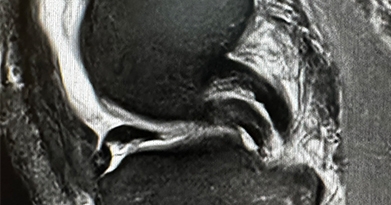
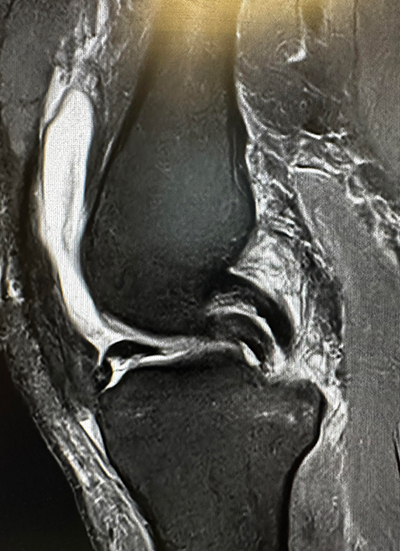
Figure 1
The meniscus acts as a shock absorber in the knee, aids in stability in the knee, and assists with the articulation of the femoral condyle and tibial plateau. There are many different types of meniscal tear patterns that occur.
Bucket handle meniscal tears are longitudinal/vertical, full thickness tears in which the attachment of the anterior and posterior roots are still intact, but often involve a large portion of the posterior horn and mid body. Bucket handle meniscal tears can be considered one of the more serious types of meniscal tears. They usually represent 10-15% of all symptomatic meniscal tears. They typically occur in younger adults after the sudden twist or pivot of the knee. However, bucket handle type tears can also occur in an older population. They characteristically have not only pain, but also locking of the knee. They can cause mechanical blocks when the torn fragment displaces in the notch of the knee. This can often be seen on an MRI, which is called a “double PCL sign.” (Figure 1) A sagittal midline cut of the knee shows two objects, which both look like the PCL.
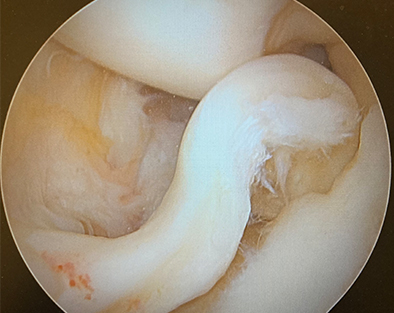
Figure 2
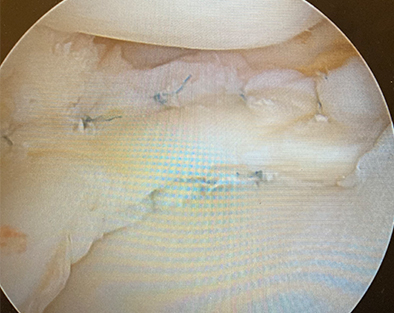
Figure 3
Bucket handle meniscal tears are serious because if not repaired, they can significantly increase the onset of arthritis in the knee. However if the bucket handle meniscal tear is appropriately repaired and heals well, the meniscus function is preserved, thereby decreasing the onset of arthritis in the knee. It is important to discuss with your surgeon about the risks and benefits of surgery for a bucket-handle meniscal tear and which approach the surgeon will take. Figure 2 shows a displaced bucket handle tear and Figure 3 shows the meniscus reduced and repaired.
The periphery, or outside rim, of the meniscus is in a rich blood zone area we call the “red-red” zone, which means the healing potential is great. The middle third of the meniscus is what we call the “red – white zone” which means blood supply is not as sufficient. Meniscus tears in these zones can repaired or debrided, based on various factors. If a meniscal tear occurs in the “white zone” which is the inner part of the meniscus, healing is potential is poor and a partial meniscectomy is often performed.
Visit an orthopedic surgeon if you experience a “pop” in your knee with pain and swelling. If you experience intermittent locking, pain and swelling you should obtain an MRI to evaluate your meniscus.
This post is for educational purposes only. Please consult with a board-certified orthopedic surgeon when seeking care for any type of musculoskeletal injury.


