


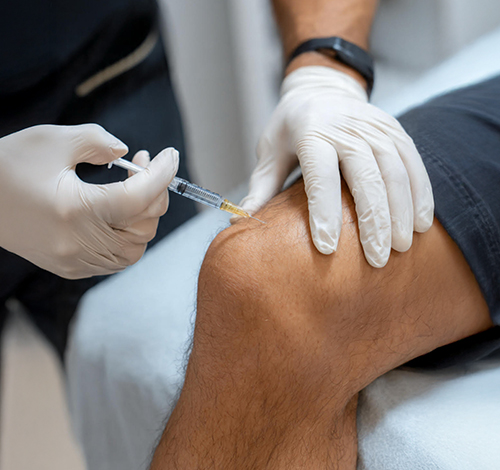
Joint injection are commonly performed everyday across the United States for various pathologies. These joint injections can be effective in reducing inflammation and pain. However, it is important that the joint injection is accurate for maximal efficacy.
Joint injections can be done in various manners. Traditionally, they have been performed with landmark guidance. This means that the physician will palpate bony and soft tissue landmarks to estimate the location for where to stick the needle in order to gain access to the joint. However, there have been studies that demonstrate that such landmark guidance can be grossly inaccurate. A recent systematic review published in the American Journal of Sports Medicine demonstrated that image guided injections are much more accurate than landmark guidance.
The table below shows the discrepancy in accuracy between image guided injections and non-image guided injections. Many of these studies were done with experienced orthopedic surgeons.
In my clinic, I routinely perform injections under ultrasound guidance to improve accuracy and efficacy of the injection. Here is a video example of one of our AC joint injections performed with ultrasound guidance. If your doctor plans to perform an injection without any guidance, have a discussion with them about the pros and cons of using ultrasound to improve accuracy so you can fully understand their reasoning.
This blog post is for educational purposes only. Please consult with a board certified physician if you feel that you need an injection for joint pain.


