

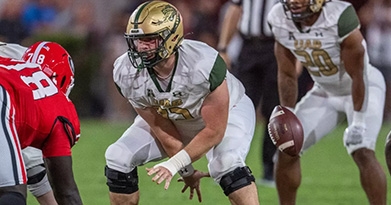
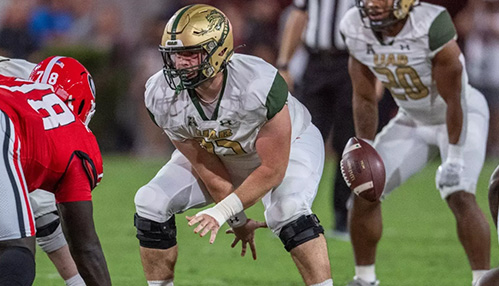
Every single snap in football involves hundreds of pounds of raw athletic force colliding. Within this chaotic grid, offensive linemen operate in a state of constant vulnerability. Their feet are firmly planted in the turf, making them prime targets for accidental low hits, falling bodies, and awkward twisting angles. For decades, players, coaches, and sports medicine professionals have debated a critical safety question: does bracing actually help football linemen?
The short answer is yes. Extensive medical research and on-field data demonstrate that prophylactic (preventative) knee bracing significantly reduces the frequency and severity of joint injuries, particularly to the medial collateral ligament (MCL) for offensive linemen. The MCL is a rope on the inside of the knee that connects the femur to the tibia and provides knee stability. Furthermore, wearing the brace does not seem to hinder in season performance based on statistics.
To understand why braces are so vital for linemen, one must look at the specific biomechanics of trench play. When a 300-pound defensive tackle gets blocked into the side of an offensive guard’s leg, it creates a massive "valgus" force. This force drives the knee violently inward while the foot remains stuck in the grass. Without protection, this exact movement tears the MCL and can even disrupt the anterior cruciate ligament (ACL). One study shows a low rate of overall incidence of ACL tears among NCAA football offensive linemen wearing bilateral prophylactic knee braces. Rigid, dual-hinged knee braces act as an external skeleton. Made from aircraft-grade aluminum or carbon fiber composites, these braces absorb the blunt force of an impact and redirect that energy up and down the rigid frames, shielding the vulnerable ligaments underneath. Additionally, many high-end lineman braces feature mechanical hyperextension stops. These physical blocks prevent the knee joint from bending backward when a player is pushed over from the front.
Despite the evidence, a cultural divide exists between different levels of play. In college football, bilateral knee bracing is a staple. Many NCAA collegiate football programs highly encourage their offensive linemen to wear them during every practice and game. The goal is simple: protect the program’s investments and safeguard the players' long-term health and draft prospects. However, in the NFL, brace usage among offensive linemen has actually declined in recent years. Many professional players argue that the rigid frames add weight, chafe the skin, and subtly restrict the explosive lateral agility needed to block elite edge rushers. They choose to trade a margin of safety for maximum speed.
Yet, multi-season athletic studies consistently show that the perceived performance deficit is largely psychological. Modern knee braces are engineered to mimic the natural tracking of the human knee, resulting in zero statistical drop in a lineman's speed, power output, or blocking efficiency once they adapt to the gear.
Ultimately, for any lineman looking to survive a grueling season intact, the benefits of bracing far outweigh the minor adjustment period. It transforms a career-threatening impact into a minor, forgettable collision.
Amit Momaya, MD is a board certified orthopedic surgeon who specializes in sports medicine. He serves as the Chief of Sports Medicine at UAB and resides on the editorial board of research journals. He has taken care of multiple high school, collegiate, and professional football athletes with MCL tears. This blog post is for educational purposes only. Please consult with your physician for a discussion on knee preservation.


