

Recently, there has been a massive surge of interest in ACL tear recovery without surgery. While some patients can successfully manage an anterior cruciate ligament (ACL) injury non-operatively, the choice between surgical reconstruction and conservative management is highly complex.
Before deciding on a treatment plan, you must understand the exact nature of your injury, the latest medical clinical approaches, and what the scientific data actually says about non-surgical healing.
Understanding Partial vs. Complete ACL Tears
The success of non-surgical ACL treatment depends heavily on whether the ligament is partially or completely torn.
- Partially Torn ACLs: These injuries have the potential to heal and provide acceptable knee stability. Success depends on the location and exact degree of the partial tear. However, caution is required; one study demonstrated that 39% of young, active patients treating a partial ACL injury conservatively eventually progressed to a complete tear. Figure (1) shows an MRI with a partially torn ACL tear that has scarred in to the PCL.
- Full-Thickness (Complete) Tears: These injuries usually do not structurally "heal" on their own. However, a proximal full-thickness tear can sometimes scar down to surrounding tissue, most commonly attaching to the posterior cruciate ligament (PCL). While this scarring can provide enough stability for everyday activities, it rarely restores perfect sports performance. Figure (2) shows an MRI that with a complete ACL tear.
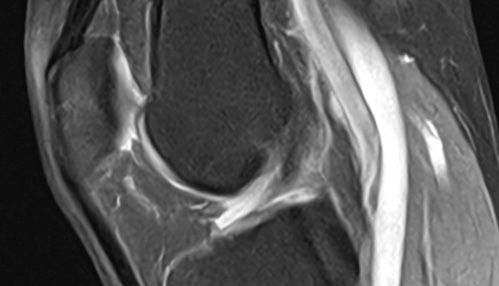
Figure 1
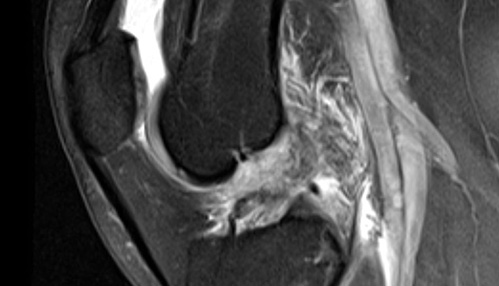
Figure 2
Why Your MRI Might Lie to You
We conducted a systematic review at UAB to evaluate the success of non-operative treatment for ACL tears. Our findings revealed a critical insight: a high percentage of patients showed persistent knee laxity (looseness) during physical testing, despite their MRI showing "fiber continuity" (looking connected).
The takeaway? An MRI cannot definitively tell you if an ACL tear is functionally healed. Instead, a well-performed physical examination-specifically a Lachman exam-is the gold standard for testing actual knee stability.
The Reality Behind New Non-Surgical ACL Protocols
Many patients researching how to heal an ACL naturally encounter specific alternative protocols. Here is what the latest orthopedic research says about them:
1. The Cross Bracing Protocol (CBP)
Pioneered by researchers in Australia, the Cross Bracing Protocol temporarily immobilizes the knee at a strict 90-degree angle during the first few weeks post-injury. The goal is to reduce the gap between the torn ligament edges to encourage natural reattachment without a surgical graft.
- The Risk: A recent study demonstrated that the Cross Bracing Protocol carries an unacceptably high failure rate when compared to traditional surgical stabilization.
2. The KANON Trial
This famous clinical trial is frequently cited by proponents of non-operative ACL management. However, the study has significant limitations that prevent it from being generalized to the public:
- High Crossover Rate: Approximately half of the patients randomized to the conservative treatment group ultimately required ACL surgery (yet they were still counted as "successes" in the non-operative data).
- Strict Exclusions: The trial completely excluded individuals with high activity levels (those who engage in pivoting sports) as well as anyone who has a meniscus tear.
3. Biologic Treatments (PRP and Stem Cells)
Some clinics heavily promote biologic treatments, such as Platelet-Rich Plasma (PRP) or bone marrow aspirate concentrate (BMAC), for treating ACL tears.
- The Reality: Currently, there is no high-level, definitive medical evidence proving that biologics successfully heal or manage ACL tears.
The Hidden Risk of Skipping ACL Surgery: Meniscus Tears
If you choose a non-surgical route, it is vital to understand the long-term biomechanical consequences. Without a functional ACL, the medial meniscus becomes the primary secondary stabilizer of the knee.
Over time, the constant shifting of an unstable knee puts immense stress on this cartilage. Leaving an ACL tear chronic frequently results in a bucket-handle medial meniscus tear down the road. Addressing an ACL injury acutely not only restores immediate stability but also protects your meniscus and joint cartilage from irreversible, long-term damage and early arthritis.
Who Is a Good Candidate for Non-Surgical ACL Treatment?
According to criteria outlined by the American Academy of Orthopaedic Surgeons (AAOS), you are more likely to thrive with conservative management if you meet the following criteria:
- Low-Demand Lifestyle: Your daily routine consists primarily of straight-line movements (e.g., walking, swimming, cycling, or desk work).
- No "Giving Way" Episodes: Your knee remains naturally stable during light, everyday physical tasks.
- Favorable Mechanical Alignment: Your natural bone structure and joint anatomy inherently protect the knee from shifting.
- Stable Partial Tears: A significant portion of your original ligament remains fully intact and functional.
Who needs surgery? Active individuals, athletes, and weekend warriors who participate in pivot-heavy or "cutting" sports-like soccer, basketball, skiing, or football-almost always require ACL reconstruction surgery to safely return to high-level competition.
Weighing the Pros and Cons
| Pros of Non-Surgical Treatment | Cons of Non-Surgical Treatment |
|---|---|
| No surgical risks or graft failure | The ligament may remain structurally lax |
| Avoidance of a lengthy, painful post-op recovery | Persistent mild instability or "giving way" |
| Faster return to daily tasks and light activities | Higher risk of secondary meniscus tears over time |
| Lower overall medical costs | Potential acceleration of early-onset osteoarthritis |
Amit Momaya, MD is a board certified orthopedic surgeon who specializes in sports medicine. He serves as the Chief of Sports Medicine at UAB and resides on the editorial board of research journals. He has taken care of multiple high school, collegiate, and professional football athletes with ACL tears and performs one of the highest volumes of ACL reconstructions in the state of Alabama. This blog post is for educational purposes only. Please consult with your orthopedic surgeon for a discussion on ACL tear management.


